


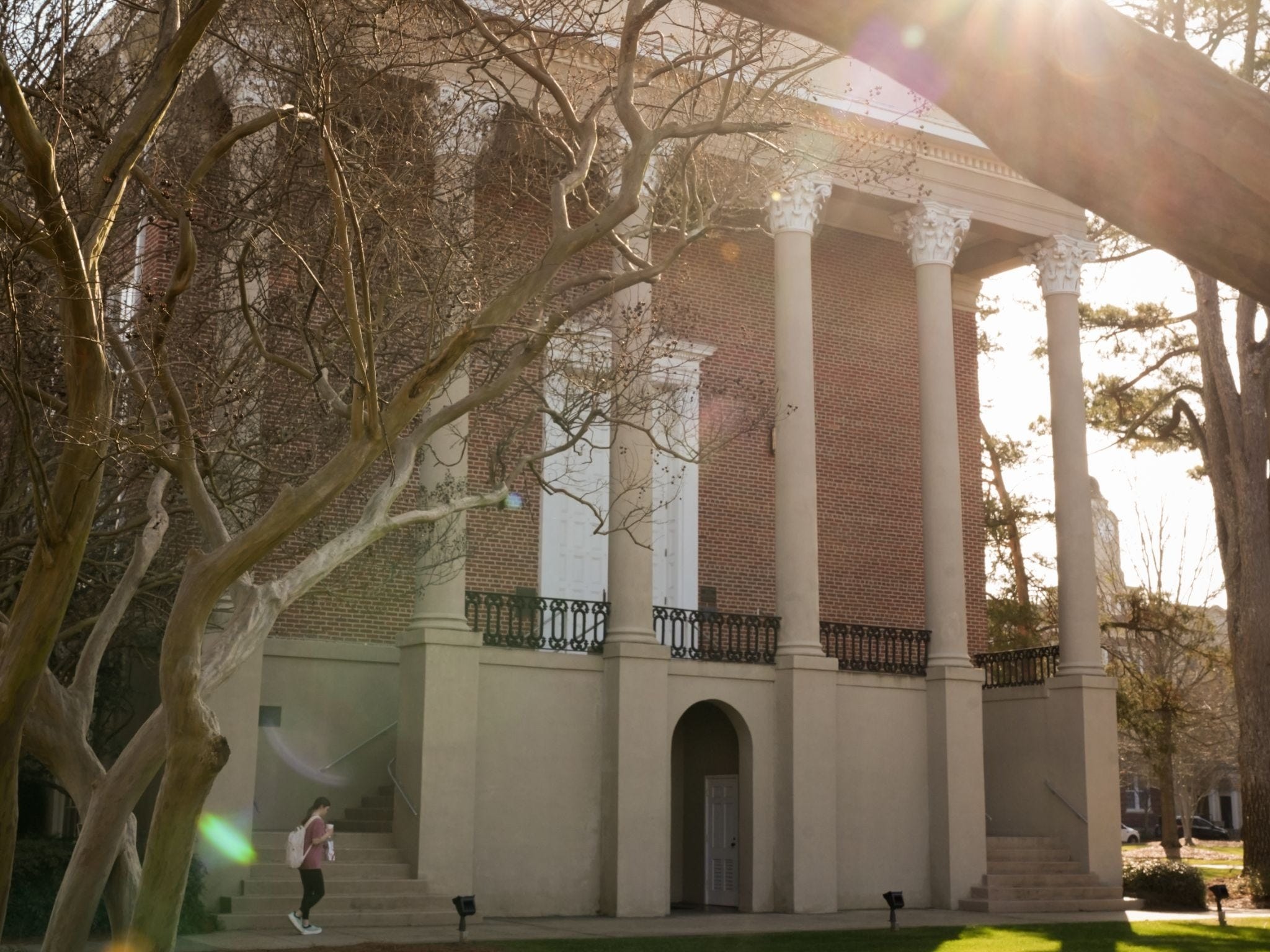
On Nov. 21, 2025, Mississippi College’s historic Provine Chapel was officially listed on the National Register of Historic Places, marking a major milestone for both the university and the Clinton community. On Feb. 12, the university recognized this achievement during ongoing bicentennial celebrations.
Stephanie Busbea, MC professor of art and dean of the School of Christian Studies, Humanities and the Arts, played a major role in the months-long process of obtaining national recognition. Busbea worked alongside others in the MC administration, including COO Laura Jackson and Archivist Heather Moore, to ensure all state and national requirements were met for Provine Chapel’s listing on the register.
Busbea commented on the recognition’s impact and how she hopes it will reach those traveling through the city. “There are people, myself included, that when we travel…we stop and look at buildings that are in the National Register of Historic Places,” Busbea said. “I think as people travel through, I am hoping they will stop and visit Provine.”

The dean said she hopes to develop additional programming for tourists, mentioning ideas such as a written self-guided tour or opportunities for student ambassadors to lead in-person experiences for tour groups.
The university’s efforts to obtain the recognition began with extensive research, led in large part by Heather Moore, head of special collections at the MC archives. “We started digging through every picture we could, old yearbooks and vertical files on Provine,” Moore said. “It was really interesting to just see these other elements as the oldest building on campus, to see how it has been used for the past 160 years.”
Busbea commended Moore and her staff on the extensive work accomplished in the past six months.
“She had tons of materials. It was amazing. She had student workers who went through every one of the minutes from all the meetings for the last 200 years to figure out, you know, ‘Who built it? Who designed how it was going to get done? Who was going to pay for it? How was it going to get paid for? How are we working with the Mississippi Baptist?’ All that stuff was in those records, those minutes. And so we were able to go through all those. But the student workers did all that work and read through all of them and just compiled it for me. So a lot of the research was made easier by what they were able to do. And Heather Moore is a master of getting all that material.”
The chapel was constructed in 1860 and is the oldest building on the Mississippi College campus. It is considered a major landmark in the city of Clinton. Built in the red-brick Greek Revival style, the chapel has served generations of students, faculty and visitors as a place of worship, reflection, and community gatherings.
The structure of the building features a full-height stone Corinthian portico, symmetrical windows and doors, a monumental pediment with dentils, and bold classical elements typical of the Greek Revival style. Its smooth, tapered columns with Corinthian capitals and elevated basement enhance the chapel’s commanding and distinctive presence. This defines the chapel as a mid-19th-century Greek Revival temple-form chapel.
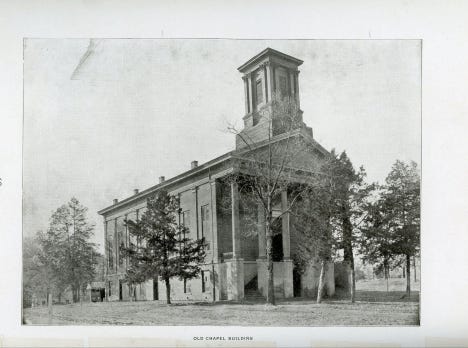
Although minor modifications occurred in the early 1900s, including the removal of the belfry and the introduction of electricity, the building has preserved its historic integrity. Renovations in the 1960s reconfigured the ground level for practical use, while the chapel level and exterior remained largely unchanged. Moore said the chapel was also renamed to honor former MC president John William Provine during this time. “It wasn’t actually named Provine Chapel until the 1960s; a hundred years before that, it was always just called ‘the old chapel’ or ‘the chapel,’” the archivist said.
The interior of Provine Chapel contains a two-story main worship space with natural lighting from large triple-hung windows, a high arched plaster ceiling, balconies on three sides supported by slender iron Corinthian columns, and a central apse illuminated by brass chandeliers.
Some later interior renovations included the addition of concrete stairs, new pews, an organ installation, removal of the baptistry and the addition of an elevator. The overall layout, architectural details, and historic character of the chapel remain largely preserved.
For additional information regarding the historical significance of Provine Chapel, the Mississippi Department of Archives and History provides an official property record that documents its architectural features, alterations, and continued historic integrity.
